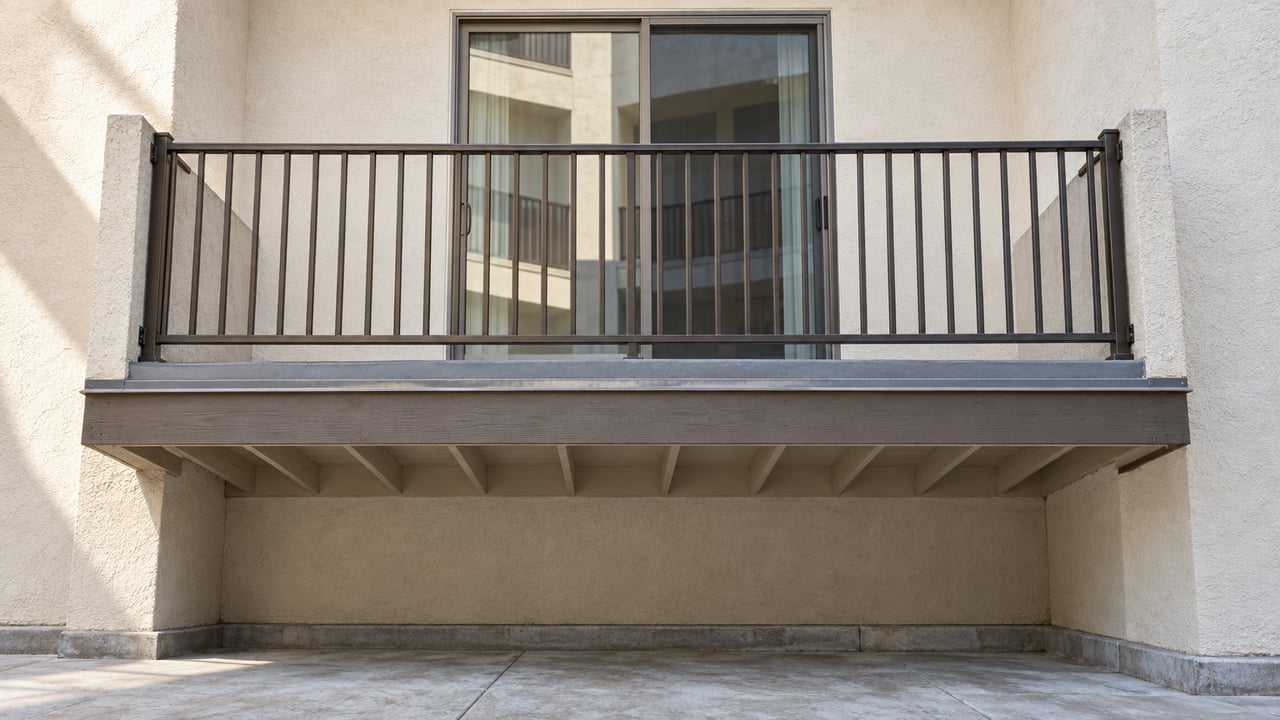
According to Bay Legal, starting this year, buyers of condos in qualifying buildings gained access to a document that used to live quietly in an HOA filing cabinet. As of January 1, 2026, sellers of those condominiums must include their association's most recent structural inspection report for balconies, decks, and other elevated wood-framed elements as part of the standard disclosure package buyers receive during escrow. The law is Senate Bill 410, and it took effect nine months ago.
For a lot of California condo buildings, this is a footnote. For a meaningful share of Encino's condo stock, it is not. Encino's condo inventory concentrates in exactly the kind of building this rule was written for: three- to five-story complexes built in the 1970s and early 1980s, framed in wood, with balconies that were never designed to be inspected this closely until a state law said they had to be.
The Law Behind the Document
Senate Bill 410 doesn't create a new inspection requirement. It attaches disclosure duties to one that already existed. Senate Bill 326, signed in 2019 and effective in 2020, added Civil Code section 5551 to California's Davis-Stirling Act, requiring condominium associations with three or more units to have a licensed structural engineer or architect inspect their exterior elevated elements, meaning balconies, decks, stairways, and walkways that are more than six feet above the ground and rely substantially on wood framing. The inspector has to examine a statistically significant sample, not just walk the property and eyeball it, and file a written report rating each element's condition and remaining useful life.
According to Rimkus, the first deadline for that inspection was January 1, 2025. Unlike the parallel law covering apartment buildings, which got a one-year extension to January 2026 under Assembly Bill 2579, the condo deadline was never pushed back. Any Encino association that manages a qualifying building was supposed to have this done more than a year and a half ago; JLK Rosenberger says a repeat inspection is due every nine years after that.
What SB 410 changed is what happens to that report once it exists. Sponsored by the California Association of Realtors, the bill amended Civil Code section 4525, the section that spells out what an HOA has to hand over during a resale, to include the most recent section 5551 inspection report. Before this year, a buyer had to know to ask for it and hope the association would produce it. Now it is a standard part of the disclosure packet, alongside the CC&Rs, financial statements, and reserve study summary.
Why Encino's Condo Stock Makes This More Than Paperwork
The buildings this law was written around are common in Encino because of when the neighborhood's condo boom happened. The Ports of Call Condominiums at 5400 Lindley Avenue went up in 1970, a three-story complex with 71 units. Encino Park, a five-story building with 68 units, was completed in 1974. A four-story, 61-unit condo building on Magnolia Boulevard with a mock Tudor stucco exterior dates to 1981. These are not rare exceptions. They are representative of the era when much of Encino's condo inventory was built, in the years right after Ventura Boulevard grew into the commercial spine it is today.
Geographically, that inventory sits mostly in one part of the neighborhood. Encino splits along Ventura Boulevard into a flatter northern section, zip code 91316, and a hillside section to the south, zip code 91436. As of mid-2026, 91316 is where condos and townhomes concentrate, with listings generally running from around $600,000 into the low $2 millions, while 91436's hillside estates trade in a different category entirely, typically $2.5 million and up. The practical effect is that a buyer shopping for a condo in Encino, which by definition means shopping in the 91316 flats, is shopping disproportionately in the same building stock this law targets.
That matters for the audience most likely to be looking at an Encino condo in the first place: first-time buyers stretching for a foothold in the Valley, and small investors looking for a rental unit with manageable carrying costs. Those are exactly the buyers with the least room to absorb a surprise five-figure repair bill or a financing delay discovered three weeks into escrow.
What Lenders and Insurers Are Asking For Before Closing
The Senate Judiciary Committee's own analysis of SB 410 spells out why this report matters beyond curiosity. A structural finding on a balcony can disqualify a unit from meeting the guidelines Fannie Mae and Freddie Mac use for conforming loans, and if a loan doesn't meet those guidelines, it becomes harder for a lender to sell, which makes lenders reluctant to originate it in the first place. In practice, that means a buyer who finds financing for a unit in a building with an unresolved inspection finding may end up with fewer loan options or none at all.
Insurance carriers are watching the same document for a related reason. Deferred maintenance and unresolved safety findings show up during policy renewal reviews, and an association that can't produce a clean report or a credible repair plan risks a non-renewal or a premium increase that gets passed through to every owner's monthly dues.
None of this runs through a government fine. Civil Code section 5551 doesn't specify a monetary penalty for a late inspection, so there's no meter running that a buyer can point to. The pressure comes from the market instead: the lender who won't fund the loan, the insurer who won't renew the policy, and now, because of SB 410, the buyer who can read the report for themselves before removing contingencies.
How an association would pay for any repair the report identifies is a fair question to raise early. The answer might be reserves, a special assessment, or a payment plan that spreads a larger cost over time, and each one changes what an owner pays after closing.
Before You Write an Offer on an Encino Condo
A few questions are worth asking the listing agent or the HOA management company before an offer goes in, not after:
- Has the association completed its section 5551 inspection, and can you see the actual report, not just a summary?
- If deficiencies were found, have the repairs been completed, and how does the reserve study account for what's left?
- When is the next nine-year inspection cycle due, and is there any indication the board is already planning for it?
- Has the association discussed or approved a special assessment tied to exterior structural repairs?
- Has your lender confirmed the building's documentation supports the loan you're applying for?
If the report doesn't exist yet, that gap is now something a buyer's agent is positioned to flag as part of standard due diligence rather than something they'd have to go digging for.
If You're the One Selling
Sellers in qualifying Encino buildings have a version of the same timing problem, in reverse. If the association hasn't completed its inspection, that absence has to be disclosed under section 4525 just as much as a completed report would be. Scheduling the inspection well ahead of listing, and getting any flagged repairs finished or at least budgeted in the reserve study, keeps a seller from finding out mid-escrow that a buyer's lender wants documentation the HOA doesn't have.
A Few Questions That Come Up
Does this apply to a single-story condo or a ground-floor unit? Generally no. The underlying law covers elevated elements more than six feet above the ground, so ground-floor patios and single-story buildings without qualifying structures typically fall outside its scope.
What about a townhome where I own the structure myself? Civil Code section 5551 applies to condominiums under the Davis-Stirling Act, where the association is responsible for the exterior. Planned developments, where each owner holds fee-simple title to their own structure and roof, generally fall outside the requirement, though it's worth confirming how a specific community's governing documents define maintenance responsibility.
What if my building's HOA says the inspection is scheduled but not done? That status is exactly what the disclosure package is meant to surface. That status is worth discussing as part of due diligence.
If you're weighing an Encino condo purchase or getting one ready to list, the HOA paperwork is worth reading before you're three weeks into escrow, not after. Nadia Arreola spent years on the property management side before moving into brokerage, and can walk you through exactly what to request from a specific building's association and what it means for your timeline.
This article is general information, not legal, tax or financial advice. Consult a qualified professional about your situation.